in

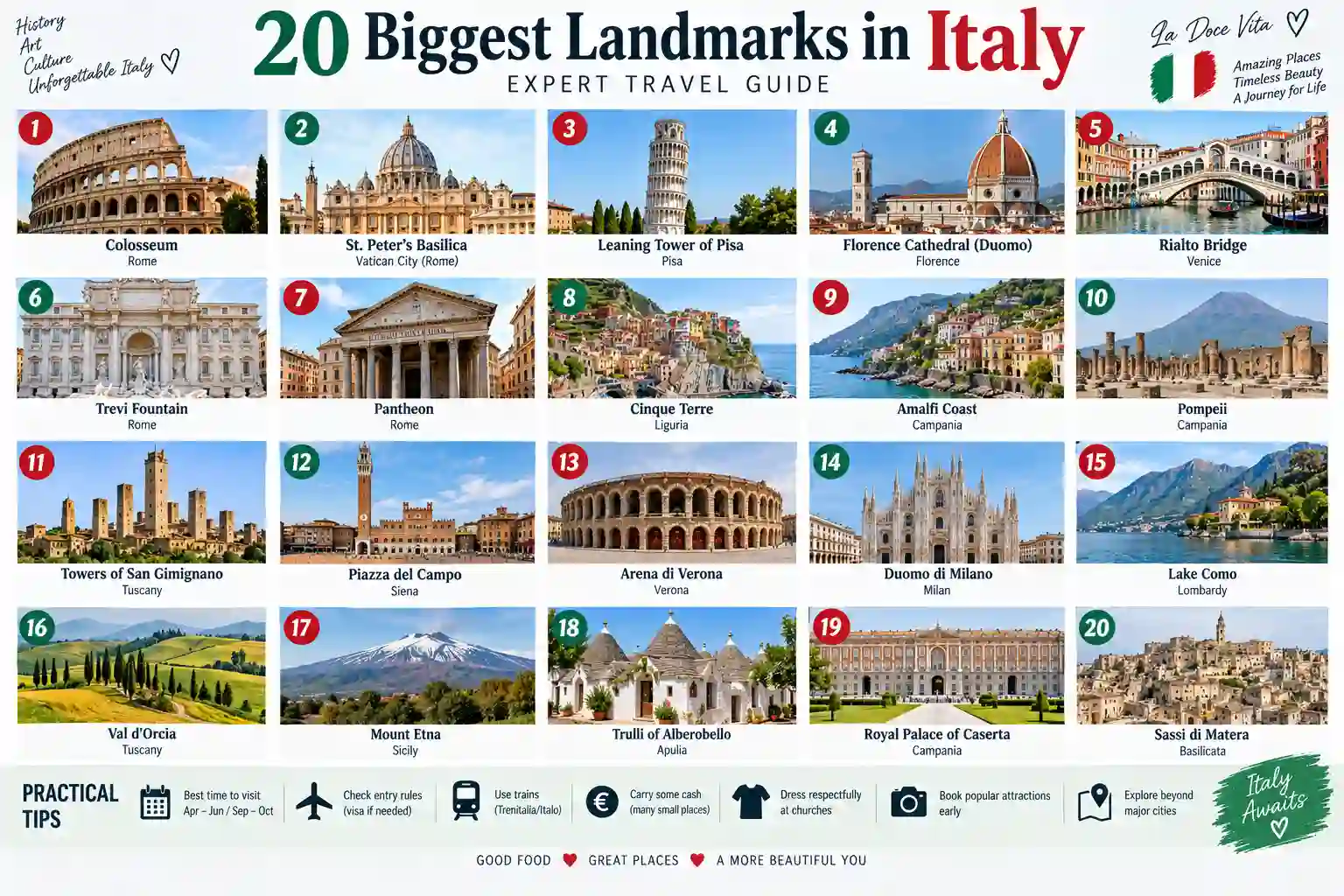
20 Biggest Landmarks in Italy | Expert Travel Guide
Table of Contents
Why Italy Has So Many Famous Landmarks
20 biggest landmarks in Italy is more than a checklist of old buildings. Italy’s most recognizable places span ancient Roman engineering, medieval cityscapes, Renaissance art, religious monuments, dramatic coastal settlements, and entire cultural landscapes. For travelers, that variety makes the country ideal for combining historic sites, cultural attractions, famous landmarks, and a broader heritage guide into one trip.
Italy currently has more UNESCO World Heritage properties than any other country, and many of the landmarks below are protected within those sites. At Things to do Global, we recommend planning by region rather than trying to cross the entire country quickly: Rome, Florence, Venice, Naples, and northern Italy each deserve focused time.
1. Colosseum, Rome
The Colosseum is the image many travelers associate with Italy first. Built in the Roman imperial era, the amphitheater still dominates central Rome and works best when paired with the Roman Forum and Palatine Hill. Book a timed ticket and allow several hours for the wider archaeological zone.
2. Roman Forum and Palatine Hill, Rome
The Forum was the political, religious, and commercial heart of ancient Rome. Walking between ruined temples, basilicas, arches, and the Palatine gives context that the Colosseum alone cannot provide. A guided tour is worth considering if you want the fragments to become a coherent story.
3. Pantheon, Rome
The Pantheon is one of the best-preserved monuments from ancient Rome and remains famous for its enormous dome and central oculus. Its compact location in the historic center makes it easy to combine with Piazza Navona, the Trevi Fountain, and nearby churches.
4. Trevi Fountain, Rome
The Trevi Fountain is one of the most photographed famous landmarks in Italy. Its theatrical Baroque design feels especially atmospheric early in the morning or later in the evening, when the surrounding lanes are less crowded.
5. St. Peter’s Basilica and Vatican City
Although Vatican City is an independent state, it is an essential stop on most Rome itineraries. St. Peter’s Basilica, the Vatican Museums, and the Sistine Chapel form one of Europe’s most important art-and-religion complexes. Dress codes and timed museum entry should be checked before visiting.
6. Florence Cathedral and Brunelleschi’s Dome
Florence’s cathedral complex is a symbol of the Renaissance city. The striped marble façade, Giotto’s Bell Tower, Baptistery, and Brunelleschi’s dome create one of Italy’s strongest urban panoramas. Climbing the dome requires a reserved slot and many stairs, but the views are exceptional.
7. Uffizi Gallery, Florence
The Uffizi is not a single monument in the usual sense, but it is one of Italy’s defining cultural attractions. Works by Botticelli, Leonardo, Michelangelo, Raphael, Caravaggio, and others make advance booking worthwhile, especially in high season.
8. Ponte Vecchio, Florence
Spanning the Arno, Ponte Vecchio is famous for its shop-lined passage and distinctive profile. Visit at sunrise for photographs, then return in the evening when the riverbanks and bridges become part of Florence’s social atmosphere.
9. Leaning Tower of Pisa
The Leaning Tower is one of the world’s instantly recognizable famous landmarks. The surrounding Piazza dei Miracoli also includes the cathedral and baptistery, so treat Pisa as more than a quick photograph stop if your schedule allows.
10. St. Mark’s Basilica, Venice
St. Mark’s Basilica reflects Venice’s centuries of trade and cultural exchange through mosaics, marble, domes, and Byzantine influence. The surrounding piazza, Doge’s Palace, bell tower, and lagoon waterfront make this one of the richest sightseeing zones in Italy.
11. Doge’s Palace and Bridge of Sighs, Venice
The Doge’s Palace was both the ceremonial center and seat of government of the Venetian Republic. Its grand halls contrast with prison passages reached through the Bridge of Sighs, making the complex one of Venice’s most compelling historic sites.
12. Grand Canal, Venice
The Grand Canal is effectively Venice’s main avenue, lined with palaces and crossed by iconic bridges. A vaporetto ride offers a practical low-cost overview, while a gondola is the more atmospheric commercial experience for travelers who want something memorable rather than purely functional.
13. Pompeii Archaeological Park
Pompeii preserves streets, houses, temples, shops, frescoes, and public spaces buried by the AD 79 eruption of Vesuvius. The scale is enormous, so comfortable shoes and a route plan matter. Pair the site with Naples, Herculaneum, or Mount Vesuvius rather than attempting it as a rushed add-on from far away.
14. Mount Vesuvius
Vesuvius gives the Bay of Naples its dramatic backdrop and provides the geological context for Pompeii and Herculaneum. Visitors can reach the upper area via organized transport or independent connections, then continue on foot toward the crater rim subject to access conditions.
15. Amalfi Coast
The Amalfi Coast is a heritage guide landmark at landscape scale rather than a single building. Cliffside towns such as Positano, Amalfi, and Ravello sit above a steep Mediterranean coastline of terraces, gardens, and winding roads. Ferries are often a scenic way to move between towns in season.
16. Cinque Terre
The five villages of Monterosso, Vernazza, Corniglia, Manarola, and Riomaggiore are linked by rail and hiking routes along the Ligurian coast. Crowds can be intense, so staying overnight and starting early creates a better experience than arriving only for midday photos.
17. Milan Cathedral
The Duomo of Milan is famous for its forest of spires and elaborate Gothic exterior. The rooftop terraces are the highlight for many visitors, giving close-up views of the stonework and an elevated perspective across the city center.
18. Lake Como
Lake Como is known for elegant villas, mountain scenery, ferries, and waterfront towns such as Bellagio, Varenna, and Como. It works well as a slower counterpoint to Milan or as part of a northern Italy road-and-rail itinerary.
19. Verona Arena and Historic Center
Verona combines Roman architecture, medieval streets, elegant piazzas, and the literary association with Romeo and Juliet. The Roman Arena remains an active performance venue, which makes it a rare landmark that is still experienced as a living cultural space.
20. The Dolomites
The Dolomites close this list of the 20 biggest landmarks in Italy with a completely different kind of monument: a mountain landscape. Their pale limestone peaks, alpine lakes, scenic drives, ski areas, and hiking routes make northern Italy essential for nature and adventure travelers.
How to Plan an Italy Landmark Trip
The smartest route depends on your interests. A first cultural trip might combine Rome, Florence, and Venice; a southern route could focus on Naples, Pompeii, Vesuvius, and the Amalfi Coast; a northern trip could connect Milan, Lake Como, Verona, Venice, and the Dolomites. High-speed trains are ideal between large cities, while local rail, ferries, or rental cars can fill regional gaps.
UNESCO’s official Italy World Heritage page lists the country’s World Heritage properties and is a useful authoritative starting point when you want to understand why particular historic sites and cultural landscapes matter.
For more destination inspiration built around architecture, archaeology, museums, and heritage, explore our culture and landmarks hub before finalizing your route.
Best Ways to Experience Italy’s Major Landmarks
A guided tour is most valuable at complex archaeological and museum sites where context changes what you see. Rome’s Forum, Pompeii, the Vatican Museums, and the Uffizi can be overwhelming without a plan, while landmarks such as the Trevi Fountain, Ponte Vecchio, and the Grand Canal are easy to enjoy independently. Mix guided visits with free wandering so the trip does not become a sequence of scheduled entrances.
Budget for more than admission tickets. Major landmarks often involve reservation fees, local transport, lockers, audio guides, or premium access such as rooftops and towers. Booking directly through official attraction websites is usually the clearest way to understand what is included and avoid confusing third-party ticket descriptions.
FAQs
1. What is the most famous landmark in Italy?
The Colosseum is often the most internationally recognizable, although the Leaning Tower of Pisa, Venice’s canals, Florence Cathedral, and the Trevi Fountain are equally iconic.
2. Which Italian city has the most famous landmarks?
Rome has the greatest concentration for first-time visitors, including the Colosseum, Roman Forum, Pantheon, Trevi Fountain, and Vatican-area attractions.
3. How many UNESCO World Heritage Sites does Italy have?
UNESCO currently lists more than sixty World Heritage properties in Italy. Because new inscriptions can be added, check UNESCO for the latest total before publishing statistics.
4. Can I see Rome, Florence and Venice in one week?
Yes, but the pace is fast. Two nights in each city plus travel time works as a highlights trip; nine to ten days feels more relaxed.
5. Is Pompeii worth a full day?
For history-focused travelers, yes. The archaeological park is large and rewards several hours, especially when combined with a guide or the nearby museum collections in Naples.
6. Do I need to book Italian landmarks in advance?
Advance booking is strongly recommended for major timed-entry attractions such as the Colosseum, Vatican Museums, Uffizi, Florence Duomo climbs, and some Venice attractions.
7. What is the best season for an Italy landmark trip?
Spring and autumn usually offer a balance of pleasant weather and manageable crowds. Summer is popular but hotter and busier, particularly in Rome, Florence, Venice, and coastal destinations.
8. Which landmarks are best for families?
The Colosseum, Pompeii, Venice’s boats, Pisa, Lake Como, and castle-like historic complexes can work well for families when you keep walking distances realistic.
9. Can I visit Italy’s landmarks without a car?
Yes. Major cities are well connected by rail. A car is more useful in rural Tuscany, parts of the Dolomites, smaller villages, and certain coastal or countryside routes.
10. What should I wear when visiting churches in Italy?
Major churches generally expect respectful dress, often including covered shoulders and knees. Carrying a light layer is useful during warm-weather sightseeing.
Final Thoughts
The 20 biggest landmarks in Italy show why the country rewards repeat visits. Ancient ruins, Renaissance masterpieces, churches, canals, coastal villages, lakes, and mountains all tell different parts of the Italian story.
Instead of squeezing every name into one trip, group nearby famous landmarks into regional routes and leave enough time for food, neighborhoods, and ordinary local life between major sights.
Tags :
example, category, and, terms