in

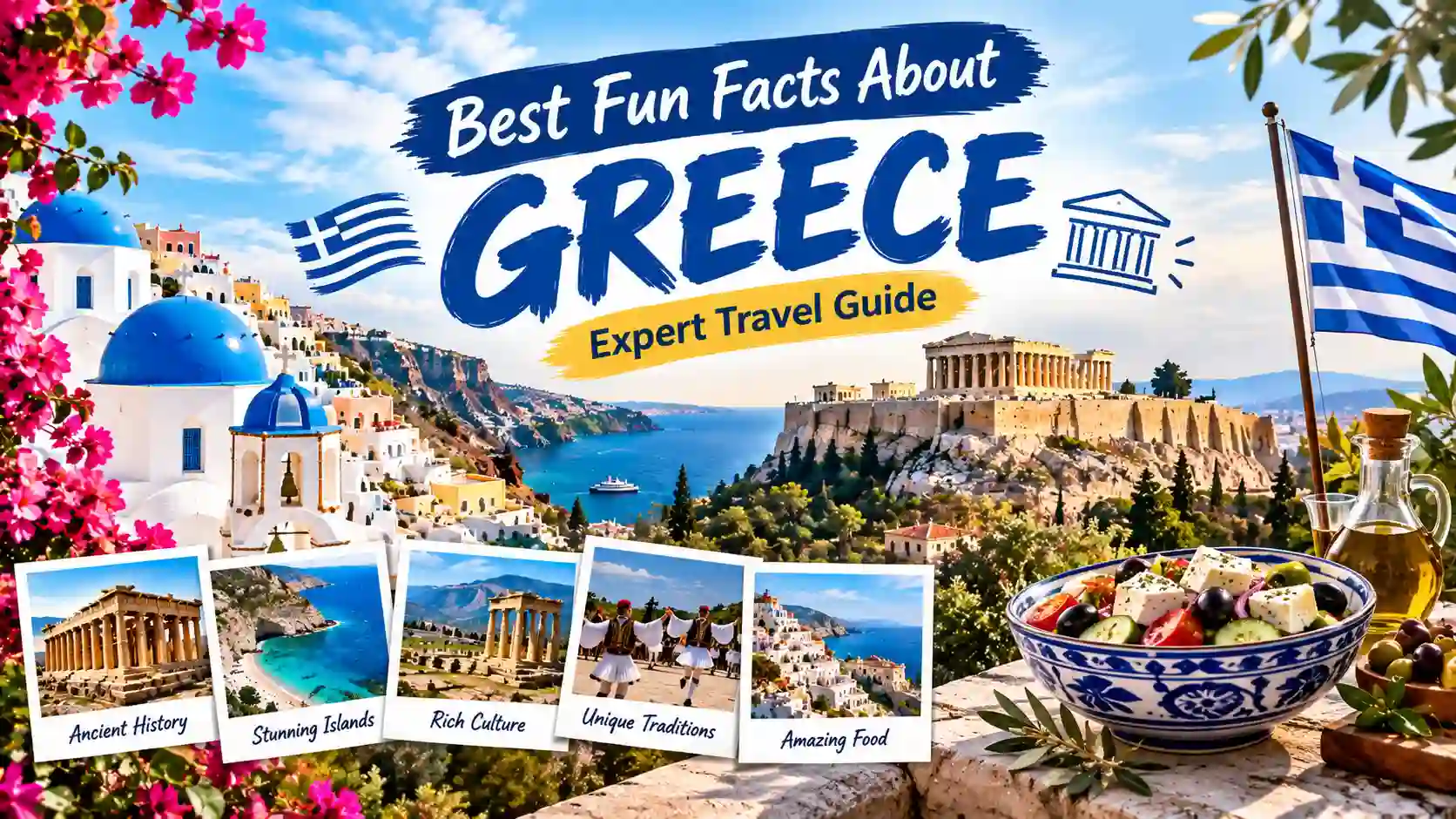
Best Fun Facts About Greece | Expert Travel Guide
Fun Facts About Greece
- Ancient History: Greece is the birthplace of democracy, the ancient Olympic Games, and one of Europe’s oldest cities, Athens.
- Thousands of Islands: Greece has thousands of islands and islets, including famous destinations like Santorini and Crete.
- Mount Olympus: Greece’s highest mountain reaches 2,918 metres and is known as the mythical home of the Greek gods.
- UNESCO Heritage Sites: Greece has 21 UNESCO World Heritage properties as of 2026, including Meteora, Mount Olympus, and ancient archaeological sites.
- Greek Food and Traditions: Olive oil, authentic feta cheese, Greek coffee culture, and Orthodox Easter are important parts of Greek heritage.
- Travel Planning: Explore Athens, ancient ruins, beautiful islands, and natural landscapes while focusing on one region for a more relaxed trip.
Table of Contents
20 Fun Facts About Greece
20 fun facts about Greece can take you from ancient democracy and the first Olympic Games to volcanic islands, mountain monasteries, olive groves and one of Europe’s most distinctive alphabets. At Things to do Global, we use facts like these as practical travel tools because they explain why certain places to visit matter and how different parts of the country fit together.
Greece is not just Athens plus a few famous islands. Its mainland, archipelagos, regional cuisines and layered history create enough variety for many separate trips. These Greece facts mix history, culture, geography and destination planning so you can turn trivia into useful trip ideas.
1. Athens Is One of Europe’s Oldest Continuously Inhabited Cities
Athens has been inhabited for thousands of years and layers ancient, Byzantine, Ottoman, neoclassical and modern history in a compact urban area. The Acropolis may dominate the skyline, but neighborhoods such as Plaka, Monastiraki and Psyrri show how the city continues to evolve around its archaeological past.
2. Democracy Has Ancient Athenian Roots
Classical Athens developed an early form of democracy in the fifth century BCE, though political participation was limited compared with modern democratic systems. Visiting the Ancient Agora helps travelers understand where public debate, administration and civic life took place.
3. The Ancient Olympic Games Were Held at Olympia
The Olympic tradition traces back to ancient Olympia in the Peloponnese, where athletic contests were held in honor of Zeus. The archaeological site preserves the stadium, temples and training areas, making it one of the most meaningful historic places to visit for sports fans.
4. The Greek Alphabet Is Still in Everyday Use
Greek uses its own alphabet, descended from ancient forms and still visible on street signs, menus and transport information. Many English scientific and mathematical symbols come from Greek letters. Learning a few characters can make signs and place names easier to recognize while traveling.
5. Greece Has Thousands of Islands and Islets
The exact count depends on how tiny rocks and islets are classified, but Greece has thousands of islands and islets and only a fraction are inhabited. That variety explains why island-hopping experiences differ so much between the Cyclades, Dodecanese, Ionian Islands, Sporades, Saronic Gulf and Crete.
6. Santorini Is the Rim of a Volcanic Caldera
Santorini’s dramatic cliffs and crescent shape are products of volcanic activity. The flooded caldera creates the steep views that make villages such as Oia, Fira and Imerovigli famous. Boat trips to volcanic islets and the hike between Fira and Oia are good ways to understand the geography.
7. Mount Olympus Reaches 2,918 Metres
Mytikas, the highest summit of Mount Olympus, reaches about 2,918 metres. In mythology the mountain was home to the Olympian gods, but today it is also a major hiking destination. Serious summit attempts require appropriate fitness, conditions and mountain preparation.
8. Mount Olympus Became a UNESCO World Heritage Property in 2026
The wider area of Mount Olympus was added to the UNESCO World Heritage List in 2026, giving Greece 21 listed properties. Check UNESCO’s official Greece page for the current list and inscription details.
9. Greece Has Three Mixed UNESCO Properties
Most Greek World Heritage properties are cultural, but Meteora, Mount Athos and the wider area of Mount Olympus are classified as mixed properties for both cultural and natural values. That combination reflects how closely Greek history is tied to landscapes.
10. Meteora Monasteries Sit on Sandstone Pillars
Meteora is one of the country’s most extraordinary sights. Monasteries were built on towering rock formations that once offered isolation and protection. Today visitors can reach several active monasteries by road and stairs, while hiking trails connect viewpoints and older paths.
11. Delphi Was Considered the Center of the Ancient Greek World
Ancient Greeks associated Delphi with the omphalos, or navel of the world. The sanctuary of Apollo became famous for its oracle and attracted visitors from across the Greek world. The steep mountain setting remains one of the site’s greatest attractions.
12. Greece Is One of the World’s Classic Olive-Growing Cultures
Olives and olive oil are fundamental to Greek food, agriculture and landscape. Groves cover hillsides from the Peloponnese to Crete and many islands. Olive harvest experiences and mill visits can be memorable seasonal additions to a food-focused itinerary.
13. Feta Has Protected Origin Status in the European Union
Feta is a protected designation product produced in specified areas of Greece using sheep’s milk or a permitted blend with goat’s milk. In local tavernas it may appear baked, whipped, in pies or simply served with olive oil and herbs rather than only in Greek salad.
14. Greek Coffee Culture Rewards Slow Travel
Coffee shops function as social spaces rather than quick fuel stops. Traditional Greek coffee, freddo espresso and freddo cappuccino all have loyal fans. Sitting for a while in a square or harbor café is a small but useful reminder not to over-schedule every day.
15. Orthodox Easter Is a Major Celebration
Greek Orthodox Easter often includes candlelit services, processions, family meals and distinctive regional traditions. Travel during Easter can be memorable, but ferries, accommodation and opening hours may operate differently, so destination planning matters more than usual.
16. The Cyclades Are Known for Whitewashed Architecture
The white cubic houses and blue accents associated internationally with Greece are especially characteristic of the Cyclades. Islands in other regions can look greener, more Venetian, more mountainous or more Ottoman-influenced, which is why choosing an island by atmosphere matters more than choosing by fame alone.
17. Crete Is Greece’s Largest Island
Crete is large enough to support a complete trip on its own, with Minoan archaeology, high mountains, long gorges, beaches and major cities such as Heraklion and Chania. Trying to cover the entire island in a few days usually means spending too much time in a car.
18. Knossos Is Part of a Newly Inscribed Minoan UNESCO Group
The Minoan Palatial Centres were inscribed on the UNESCO World Heritage List in 2025. Knossos is the best known of these Bronze Age palace sites and is closely associated with myths of King Minos, the Minotaur and the Labyrinth.
19. Greece Has Important Venetian and Byzantine Heritage Too
Ancient ruins receive most attention, but Greece also preserves remarkable medieval and early modern heritage. The Old Town of Corfu, the Medieval City of Rhodes, Byzantine monuments of Thessaloniki and fortified towns such as Mystras broaden the historical picture considerably.
20. The Best Greek Trips Usually Focus on One Region
Perhaps the most useful of these 20 fun facts about Greece is practical: the country looks compact on a map, but ferries, mountain roads and island distances can consume time. Choosing one island group or one mainland region produces a calmer and often more authentic trip than trying to collect destinations.
How to Turn Greece Facts Into a Better Itinerary
Start by deciding whether your priority is archaeology, islands, food, hiking or a balanced mix. Then choose destinations that sit naturally on the same route. Our global travel destinations hub can help with broader trip ideas and destination planning before you book.
A week is enough for Athens plus one island or mainland excursion. Ten to fourteen days opens up a second region without constant transfers. In summer, reserve ferry seats, popular hotels and rental cars in advance, while shoulder seasons often offer more flexibility and cooler sightseeing weather.
What These Greece Facts Mean for Travelers
The most useful way to read 20 fun facts about Greece is to notice how often geography and history overlap. An archaeological site may sit beside a beach, a monastery may depend on the mountain around it, and a regional dish may reflect an island’s climate and agriculture. That is why a flexible route usually works better than a checklist built only around famous names.
For cultural travelers, pair Athens with Delphi, the Peloponnese or Thessaloniki. For outdoor trip ideas, consider Zagori, Mount Olympus or Crete. For island time, choose one group and move slowly enough to learn the differences between villages, food and beaches. The country rewards curiosity far more than speed.
Practical Greece Travel Tips
In July and August, heat can make archaeological sightseeing tiring, so early starts, water, sun protection and midday breaks are valuable. Ferry schedules are seasonal and weather can affect crossings, especially on windy days. Keep important connections conservative rather than booking a ferry and international flight too close together.
Cards are widely accepted, but some cash is useful. Respect dress expectations at monasteries and churches, and check opening hours before long drives.
FAQs
1. What are the most interesting facts about Greece?
Highlights include the ancient origins of democracy and the Olympic Games, the Greek alphabet, thousands of islands, major UNESCO sites, Mount Olympus, Mediterranean food and a long Orthodox tradition.
2. How many UNESCO World Heritage Sites does Greece have?
As of 2026, Greece has 21 World Heritage properties: 18 cultural and three mixed cultural-natural properties.
3. What is the highest mountain in Greece?
Mount Olympus is the highest mountain, with Mytikas reaching about 2,918 metres.
4. How many Greek islands are inhabited?
Greece has thousands of islands and islets, but only a small fraction are permanently inhabited. Exact totals vary depending on classification.
5. What is Greece famous for eating?
Greece is famous for olive oil, feta, grilled seafood and meat, pies, legumes, yogurt, honey, fresh vegetables and regional cheeses.
6. What is the best month to visit Greece?
May, June, September and early October are popular for sightseeing and beaches with fewer peak-summer crowds. Weather still varies by region.
7. Is Santorini a volcano?
Santorini is part of an active volcanic system. Its famous caldera landscape was shaped by major eruptions over thousands of years.
8. Why are many Greek island houses white?
Whitewashed buildings are especially associated with Cycladic islands. The style reflects local building traditions, climate and historic public-health practices, though architecture varies greatly around Greece.
9. Is Greece easy to travel without a car?
Athens and many island towns are easy without a car, but rural mainland regions and larger islands such as Crete are often easier with one.
10. How should I plan my first Greece trip?
Combine Athens with one island group or one mainland region, allow realistic transfer time, and avoid booking ferry connections too tightly.
Final Thoughts
These 20 fun facts about Greece connect the country’s famous ancient past with the landscapes and traditions travelers experience today. The most rewarding trips usually mix one or two headline sites with smaller towns, long meals, beaches or mountain walks.
Use the facts to choose a theme, not to build a checklist. Greece rewards repeat visits, so there is no need to fit Athens, Crete, Santorini, Meteora and the Peloponnese into the same rushed week.
Tags :
example, category, and, terms