in

20 Fun Facts About Portugal | Expert Travel Guide
Table of Contents
20 Fun Facts About Portugal
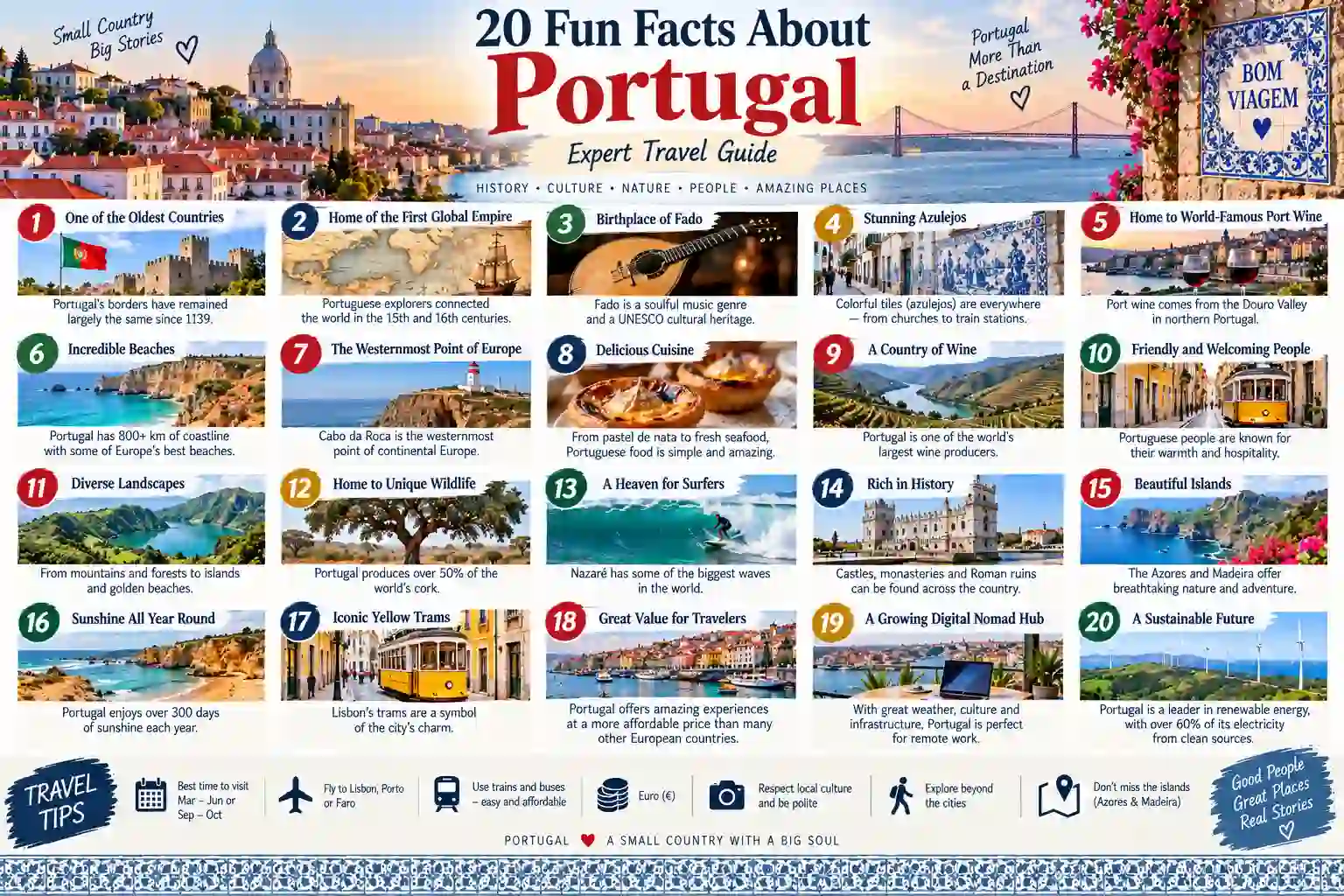
20 fun facts about Portugal reveal why this relatively compact country has such an outsized cultural footprint. Portugal is known for Atlantic exploration, tiled façades, port wine, fado, cork, surf beaches, historic cities, island landscapes, pastries, and one of Europe’s oldest national identities. At Things to do Global, we think these details make Portugal easier to understand before you build an itinerary.
Use this travel guide as both a conversation-friendly list of facts and a source of places to visit, trip ideas, and practical destination planning. Several facts lead directly to experiences you can book or add to a route.
1. Portugal Is One of Europe’s Oldest Nation-States
Portugal’s borders have been remarkably stable for centuries, which helps explain the strength of its national identity. Medieval castles, fortified towns, monasteries, and royal cities make the country’s long history visible far beyond Lisbon and Porto.
2. Lisbon Is One of Europe’s Oldest Capital Cities
Lisbon’s history predates many modern European capitals. Phoenician, Roman, Moorish, medieval, and modern layers can all be traced around the city, especially in Alfama, Baixa, Belém, and archaeological sites beneath the streets.
3. Portuguese Is Spoken Far Beyond Portugal
Portuguese is a global language spoken in Europe, South America, Africa, and parts of Asia. That international reach reflects centuries of maritime exploration, trade, empire, migration, and cultural exchange.
4. Portugal Is a World Leader in Cork
One of the most surprising 20 fun facts about Portugal is its dominance in cork. Portugal tourism’s guide to cork describes the country as the world’s largest cork producer, responsible for more than 60 percent of global cork exports. Travelers see cork used in wine stoppers, fashion, accessories, interiors, and souvenirs.
5. Fado Is UNESCO-Recognized Intangible Heritage
Fado combines music and poetry and is strongly associated with Lisbon. UNESCO inscribed Fado on the Representative List of the Intangible Cultural Heritage of Humanity in 2011. Hearing it in a small venue can be one of the most atmospheric local experiences in the capital.
6. Port Wine Comes From the Douro Region
Port wine is closely tied to the Douro Valley and the city of Porto, where historic lodges across the river in Vila Nova de Gaia age and present the wine. A Douro day trip can combine vineyards, viewpoints, river scenery, and tastings.
7. The Douro Is Also a UNESCO Cultural Landscape
The Alto Douro Wine Region is inscribed on UNESCO’s World Heritage List. Terraced slopes, villages, vineyards, roads, and the river create a landscape shaped by centuries of wine production.
8. Portugal Has a Strong Azulejo Tradition
Decorative ceramic tiles, or azulejos, appear on churches, railway stations, palaces, homes, and public buildings. Porto’s São Bento Station and Lisbon’s tiled façades are famous examples, but smaller towns often reveal equally beautiful details.
9. Pastéis de Nata Are Only the Beginning
The custard tart is Portugal’s best-known pastry abroad, but regional sweets are far more varied. Many recipes grew from convent traditions using egg yolks and sugar. Trying local pastries becomes an easy food theme when traveling between towns.
10. Portugal Has a Deep Atlantic Surf Culture
The Atlantic coast creates strong surf conditions, with destinations such as Ericeira, Peniche, Nazaré, and the Algarve attracting beginners and experienced surfers. Lessons and surf camps are widely available, making the sport accessible even on a short trip.
11. Nazaré Is Famous for Giant Waves
Nazaré became internationally known for enormous waves generated by underwater geography offshore. Even if you do not visit during a major swell, the viewpoint, lighthouse area, beach, and fishing-town identity make it a worthwhile coastal stop.
12. Portugal Includes the Azores and Madeira
The country extends far into the Atlantic through two autonomous island regions. Madeira is known for steep mountains, levada walks, gardens, and subtropical scenery, while the Azores offer volcanic lakes, geothermal landscapes, whale watching, and dramatic green countryside.
13. Sintra Looks Like a Fantasy Landscape
Sintra’s palaces, wooded hills, estates, and gardens form a UNESCO-listed cultural landscape close to Lisbon. Pena Palace is the most colorful attraction, but Quinta da Regaleira, the Moorish Castle, and the historic center make the area worth a full day.
14. Portugal Has 17 UNESCO World Heritage Properties
UNESCO currently lists 17 World Heritage properties in Portugal, including the historic centers of Porto, Évora, and Guimarães; the Cultural Landscape of Sintra; the Alto Douro Wine Region; monasteries; and Madeira’s Laurisilva forest. This gives heritage-focused travelers plenty of route options.
15. The Age of Exploration Still Shapes Lisbon
Belém Tower, the Jerónimos Monastery, maritime museums, monuments, and riverfront spaces recall Portugal’s role in early modern ocean exploration. Modern interpretation should also acknowledge the trade, empire, colonization, and human consequences connected to that history.
16. The Algarve Is More Than Resort Beaches
The Algarve is famous for golden cliffs and beaches, but inland villages, walking routes, local markets, and the less-developed western coast add variety. Kayaking and boat trips are popular, although sea conditions can affect access to caves and coves.
17. Porto’s Historic Center Climbs Above the Douro
Porto is visually defined by steep streets, tiled churches, bridges, riverfront buildings, and port lodges. The city works especially well for travelers who enjoy food, photography, short walks, viewpoints, and day trips into wine country.
18. Portuguese Pavements Are an Art Form
Calçada portuguesa uses small black-and-white stones arranged in geometric or pictorial patterns. Look down while walking in Lisbon, Porto, and other cities and you will notice how sidewalks become part of the urban design. They can also be slippery when wet, so choose shoes with grip.
19. The Country Has Remarkable Regional Variety
Northern Portugal feels greener and more mountainous, the Alentejo opens into wide rural landscapes, the Algarve is shaped by the coast, central Portugal is rich in monasteries and historic towns, and the islands feel almost like separate nature destinations. This diversity is one of the most useful 20 fun facts about Portugal for itinerary planning.
20. Portugal Rewards Slow Travel
Distances are manageable, but the country is best experienced without rushing. Café stops, viewpoints, markets, coastal walks, village lunches, and spontaneous detours often become the most memorable parts of a trip. A slower schedule also makes train and bus travel more practical.
How to Turn These Portugal Facts Into a Trip
For a first visit, seven to ten days can combine Lisbon, Sintra, Porto, and one additional region. Add the Douro for wine, the Algarve for beaches, central Portugal for monasteries and medieval towns, or Madeira/Azores for nature. Travelers with two weeks can combine city culture with a slower regional route.
UNESCO’s official Portugal World Heritage page is a useful reference for current World Heritage listings and can help you turn these facts into a heritage-focused itinerary.
For more route ideas beyond Portugal, explore our global travel destinations hub.
A Few More Portugal Travel Details Worth Knowing
Portugal’s mainland uses the same time zone as the United Kingdom in winter, while the Azores are one hour behind mainland Portugal. The country uses the euro, and English is widely spoken in major visitor areas, although learning simple Portuguese greetings is appreciated and can improve everyday interactions.
Rail is useful between Lisbon, Porto, Coimbra, and several major towns, while buses extend the network to many places without train stations. In Lisbon and Porto, steep streets can make short map distances more tiring than expected, so trams, metros, funiculars, and taxis can be practical rather than indulgent.
Best Seasons for Different Portugal Experiences
Spring works well for city walks, wildflowers, and road trips; summer is strongest for beach time but busier and more expensive; autumn suits wine regions and warm coastal travel; winter brings quieter cities, greener landscapes, and changeable Atlantic weather. Madeira and parts of the Algarve remain popular when travelers elsewhere in Europe are looking for milder conditions.
FAQs
1. What is Portugal famous for?
Portugal is famous for Lisbon and Porto, port wine, fado, azulejo tiles, cork, Atlantic beaches, surfing, historic towns, the Algarve, Madeira, the Azores, and pastéis de nata.
2. What is the most surprising fact about Portugal?
Many travelers are surprised that Portugal is the world’s largest cork producer and that cork is used far beyond bottle stoppers, including fashion, construction, and design.
3. Is fado Portuguese?
Yes. Fado is strongly associated with Lisbon and Portuguese identity, and UNESCO inscribed it as Intangible Cultural Heritage in 2011.
4. How many UNESCO World Heritage Sites does Portugal have?
UNESCO currently lists 17 World Heritage properties in Portugal. Always verify the current number because future inscriptions can change the total.
5. Is Portugal good for a road trip?
Yes. A car is especially useful for rural areas, beaches, wine regions, and smaller towns, although Lisbon, Porto, Sintra, and many major destinations are accessible by public transport.
6. What food should I try in Portugal?
Try pastéis de nata, bacalhau dishes, grilled fish, bifanas, regional cheeses, seafood, pastries, petiscos, and local wines.
7. When is the best time to visit Portugal?
Spring and autumn are excellent for city sightseeing and road trips. Summer is popular for beaches, while winter can be appealing for quieter cities and mild southern destinations.
8. Are the Azores and Madeira part of Portugal?
Yes. Both are autonomous regions of Portugal located in the Atlantic Ocean and are known for distinctive volcanic and subtropical landscapes.
9. Is Portugal easy to travel without a car?
For major cities and popular rail corridors, yes. A car becomes more useful when exploring remote beaches, rural villages, vineyards, and less-connected natural areas.
10. How many days should I spend in Portugal?
Seven to ten days works for Lisbon, Porto, and one additional area. Two weeks allows a slower route with more regional variety.
Final Thoughts
These 20 fun facts about Portugal show how much variety fits into a relatively small country. Historic cities, Atlantic culture, wine regions, music, tiles, islands, surf, and food all give travelers different ways to build a trip.
Use the facts that match your interests as route anchors: fado and history in Lisbon, port wine and the Douro in the north, surf along the coast, heritage towns inland, or volcanic landscapes in Madeira and the Azores.
Tags :
example, category, and, terms